The context
RSA Ireland is the Irish national road safety agency and also issues driver’s licenses. An excessive number of calls to the customer care center about long waiting times to schedule the driving test led the organization to ask for help in understanding what was preventing people from completing the digital journey planned in its new digital strategy.
What I did
As research lead, I took a research-first approach, in three stages: assessing the existing documentation, systems, and operations, with interviews with the teams; analyzing the real learner driver journey, with user interviews; and compiling everything in an actionable format. I also ran an on-site contextual inquiry with the teams and a final workshop for the future-state Service Blueprint.
What the research showed
Most learner drivers used the website very little, if at all. They got information from friends and family or by calling the customer care center, the opposite of what the digital strategy expected.
There were many proto-personas and journeys but no single service vision, and in practice nobody on the team was using them. I proposed replacing personas with a Jobs-to-be-done approach, which changed how the organization came to understand its users.
Some internal processes were new and improvised, a result of a digital launch brought forward by the Covid-19 pandemic. The teams could not yet guide people well in the FAQ section.
What was delivered
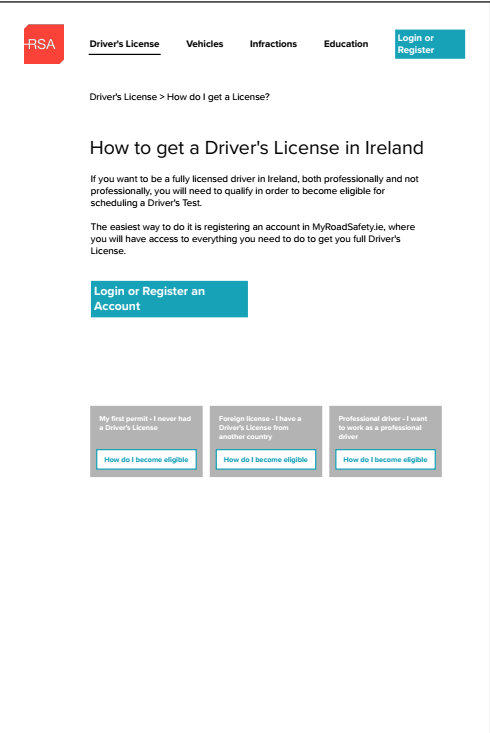
A sketch of the current-state Service Blueprint, with the most common roadblocks aligned to the journey stages; a “one stop shop” mock-up bringing together all the services needed to get a license; usability, heuristic, and accessibility evaluations, with quick wins to improve the experience immediately; and a Service Blueprint Playbook, with the framework for implementing and maintaining the future state.
Sketch of the current-state Service Blueprint. The most common roadblocks are summarized on the lowest road, aligned with the journey stage where they occurred.